
LexAgent now searches the council information of more than 300 municipalities
Council proposals, motions with their voting results, decision lists and debates from more than 300 Dutch municipalities are now a source in LexAgent, alongside national law, municipal bylaws and, recently, EU law. What has been added since July, and why the work wasn't in fetching the documents but in making them usable.

Jelle Glebbeek AI developer
8 min read

Update, October 2026: LexAgent is now also a product of its own. At lexagent.nl you check a letter, decision or contract against the official legal sources, or connect LexAgent to Claude, ChatGPT or your own agent. In vragen.ai it stays a source we switch on for your agent.
In July we introduced LexAgent: an external source that lets your vragen.ai agent consult Dutch law, local regulations, official publications and case law alongside your own content. A lot has been added since that first version. The biggest addition is for municipalities: the documents of the municipal council itself. Council proposals, motions with their voting results, decision lists, answered council questions and the recordings of the debate, from iBabs and the other council information systems, for more than three hundred municipalities.
This article is mostly about that source and what it means for a municipality. But first, briefly: what has changed since July?
What's been added since July
The first version of LexAgent had four sources: legislation, local regulations, official publications and rulings. There are now seven.
- EU legislation. Regulations, directives, decisions and treaty articles from EUR-Lex, in the consolidated Dutch text. Here too, the agent can take the version that applied on a given date. For a directive, it sees which Dutch law implements it, so it can step through to the national text.
- Case law of the Court of Justice of the EU. Judgments, orders and Advocate General opinions, searchable by subject, party, case number or ECLI. From a European regulation, the agent sees which judgments interpret it, and the other way around.
- Council information from municipalities, provinces and water authorities. That's what the rest of this article is about.
A lot has improved under the hood as well. Documents that only exist as a PDF are now made readable, older EU texts without modern markup can still be read, and for each customer we decide which sources the agent may use. A municipality's agent doesn't need to search European case law if the questions are never about it.
Why the municipal council had to be in there
Say a resident asks the municipality's assistant why the dog tax was abolished. Or why dogs are no longer allowed off the leash in a particular park. The rule was already in LexAgent: the bylaw or the general local bylaw (the APV) from the local regulations, in the version that applies today. The reason wasn't. That's in the council proposal, in the motion the council adopted, in the debate and in the decision list. Exactly the documents a resident, a council member or a journalist looks for, and that no editor could ever retype on the website.
Those documents are public. Every municipality publishes them in its council information system, and iBabs is the biggest of those: according to Digimonitor, about 47 percent of Dutch municipalities use iBabs, followed by Notubiz at 38 percent. That's why the internal request sounded like "add iBabs". But one supplier is too narrow: what matters is the council information of all municipalities. For that we use OpenBesluitvorming, an initiative that grew out of Open Raadsinformatie by VNG Realisatie and the Open State Foundation. It collects the documents from iBabs, Notubiz, GemeenteOplossingen and Parlaeus in one place: more than 5.5 million documents from 307 municipalities, 13 water authorities and 8 provinces, updated every night. If your municipality works with iBabs, your documents are in there. With Notubiz, too.
The work wasn't in fetching
Public isn't the same as usable for an agent. A council meeting is an agenda with thirty documents, a council proposal is a twenty-page PDF and a debate is an hour of spoken word. Throw all of that into a language model at once and the answer gets lost in the noise. So the real work was in two things: caching carefully, and cutting the documents into parts an agent understands.
Caching carefully
OpenBesluitvorming is a public service without a login, with a budget of sixty requests per minute that all LexAgent users share. One agent that searches five times and opens five documents already uses a sixth of that. That's why LexAgent remembers what it fetches: search results for a few hours (the index is rebuilt at night, so refreshing more often makes no sense), documents for a week (they don't change once published). If two agents ask the same question at the same time, one request goes out and they share the answer. And if the budget does run out, the source says how long the agent should wait, and it actually waits that long instead of retrying.
Cutting documents into parts that make sense
Each type of document gets its own structure, so the agent only reads what it needs:
- A document (council proposal, council letter, decision list) is split on its own headings, in blocks of a few paragraphs at most. The agent can search within the document and gets the passage back with the heading above it, so the source reference is accurate down to the section.
- A meeting becomes an agenda: for each agenda item, the related documents, the motions and amendments with their results, and the recording with chapters. The agent only opens the agenda item the question is about.
- A motion starts with what matters: adopted or rejected, the vote count and the votes per party where the council votes digitally. Only then comes the text. About forty percent of motions have no text attached, and LexAgent says so when that's the case.
- A recording has an automatic transcript, without speakers. The agent is instructed to report it as "said in this meeting" and never as a quote from a named council member.
And one rule comes before everything else: council information is context, not law. A motion binds no one and a council proposal isn't a decision yet. So LexAgent tells the agent to use council documents to explain why a rule is the way it is, and to always quote the rule itself from the bylaw. Without that instruction, a language model would cite a council proposal as if it were the adopted text.
Where the source link goes
Every answer from council information gets a source reference with the municipality, the title of the document and the meeting where it was discussed. In the demo below, that reference usually links straight to the document as OpenBesluitvorming stores it: you open the PDF and check for yourself. For a municipality, the link can point to its own iBabs environment on request, so a resident lands on the familiar council site, at the agenda item with all the related documents.
How your agent looks something up
An example. A resident asks the municipality's assistant: "Why can't my dog run off the leash in the park anymore?" The answer sits in two sources: the APV for the rule, and the council for the reason.
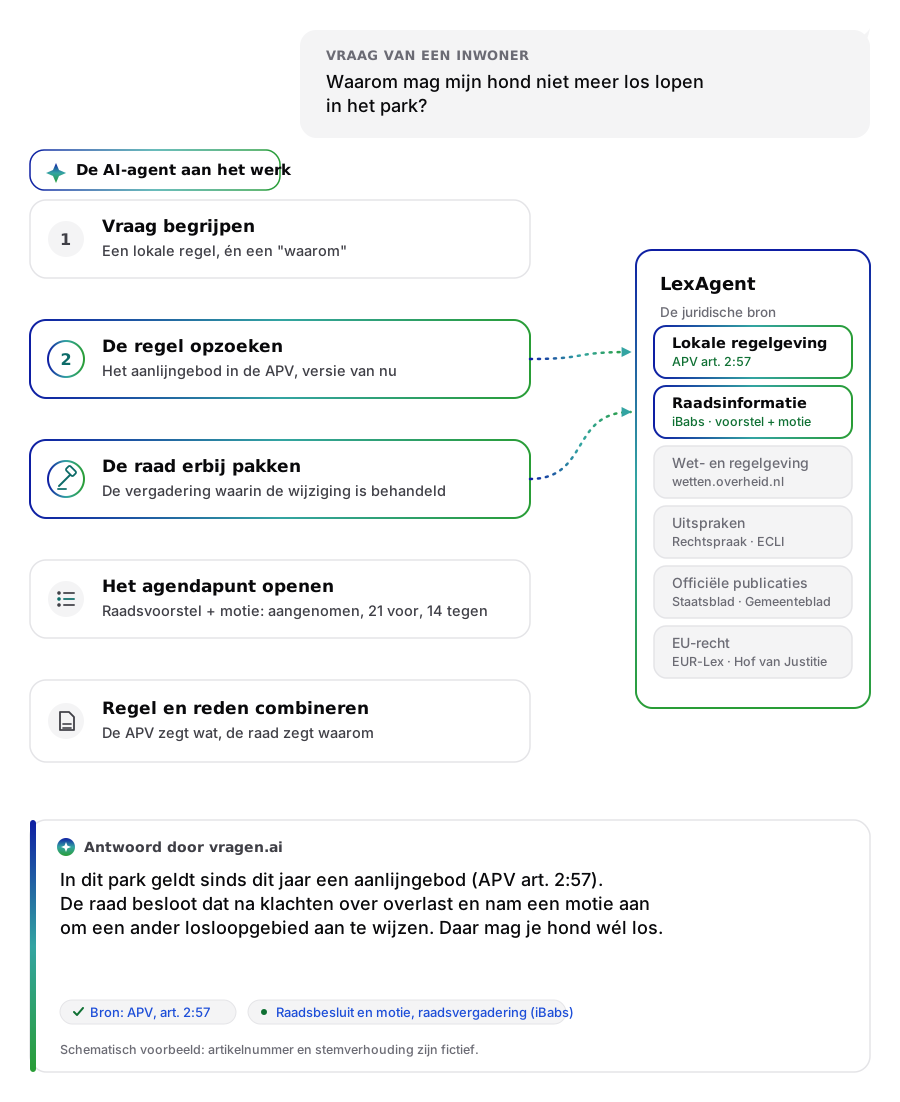
- Understanding the question. The agent recognizes a question about a local rule, with a "why" in it. The APV doesn't answer that second part.
- Looking up the rule. It searches the municipality's local regulations and finds the APV article on the leash requirement, in the version that applies today.
- Bringing in the council. It searches the same municipality's council information for the meeting where the change was discussed, and finds the agenda item with the council proposal and a motion.
- Opening the agenda item. It reads only that agenda item: the explanation in the proposal and the motion, with its result and vote count.
- Answering with the source. The agent explains in plain language that a leash requirement applies in this park, why the council decided on it and where dogs can run free. The rule points to the APV article, the reason to the council decision.
The same route works for "what did the council decide about the dog tax", "which motions on housing were adopted this year" and "what was the answer to the council questions about the library". Questions that used to end up with the council clerk's office or in a search box full of PDFs.
Try it yourself
Below is an agent with LexAgent connected, including council information. Ask it a concrete question about a decision by a Dutch municipal council, or about a law or an APV. You get an answer with the source included. Stick to one clear question; if you want more extensive research across several municipalities or decisions, create a demo.
Who is this for?
Municipalities first of all. An assistant on the municipal website that knows the rule and the decision behind it answers questions that now land with the council clerk's office, the customer contact center or in a council member's inbox. Provinces and water authorities can do the same: their documents are in the same source. And for organizations that follow municipal policy, from advocacy groups to local newsrooms, it's a way to query three hundred councils at once.
Your own content stays the foundation of your agent; LexAgent fills in where the law, the APV, a ruling or now a council decision holds the real answer. How that fits with the rest of what vragen.ai does for municipalities is on vragen.ai for municipalities; the case for government as a whole is on the government page.
Want to try LexAgent with council information for your municipality? Email service@vragen.ai and we'll set it up for you. Want to use LexAgent on its own, in your own work or in your own AI assistant? Start at lexagent.nl.