
Lisette Vredenburg
Product Owner
At SWIS, we see this development happening daily. Not only in technology, but also in how organizations design their digital services. AI is no longer an experiment; it is becoming a permanent part of how you help, guide, and prompt visitors to take action.
That is why we are continuing to develop vragen.ai this year. In doing so, we are focusing on two important themes that are closely connected: the Conversation Management System (CvMS) and self-reliance.
The shift: from RAG to Conversation Management System
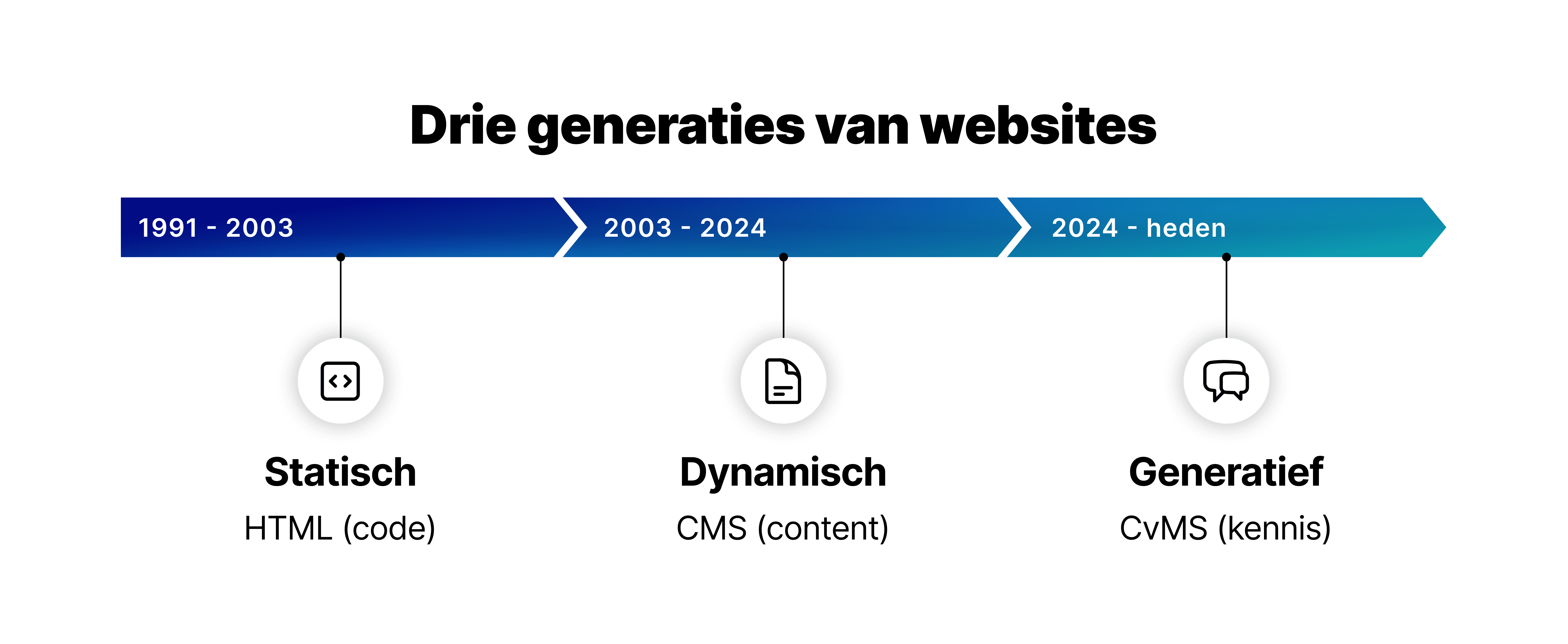
We previously wrote about the transition from traditional websites to a more conversational and generative way of interacting (see also the article on Frankwatching and our earlier piece on agents, MCPs, and widgets).
The core of this development is simple but important: it is no longer just about providing answers, but about helping to achieve a goal. Users do not come to search, but to achieve something. This means that the systems we use must also change. A standalone chatbot or search function is no longer enough. What is needed is a system that understands intent, combines information, executes actions, and at the same time steers for quality and results. That is what the concept of a Conversation Management System is all about.
With our roadmap, we are working step-by-step towards such a system.
Theme 1: Conversation Management System (CvMS)
Within this theme, the focus lies on strengthening the foundation needed to make conversational interaction not only possible, but also highly manageable and scalable.
The knowledge layer as a foundation
One of the most important components of vragen.ai is the knowledge layer. Where traditional systems often treat content as separate elements, here it is all about coherence. The system must understand where information comes from, how sources are connected, and in which context something is relevant.
In doing so, we do not only look at text, but also at other forms of information, such as images, videos, and documents. Keeping information up-to-date is also important. Information changes constantly, and the system must be able to handle this without reliability decreasing.
The focus is therefore not on adding as much new content as possible, but on smartly organizing and using existing information. Ultimately, the AI must not only be able to find something, but also understand how knowledge is interconnected.
Brand identity and governance
Now that AI is playing a larger role in organizational communication, it is crucial that this communication remains consistent and controlled. After all, the AI speaks on behalf of the organization.
That is why we are working on a central hub where organizations can not only define their tone of voice, but also the underlying rules and goals that guide the AI's behavior. This ensures that the interaction continues to fit the organization's identity and positioning.
An important part of this is managing escalations. There are always situations where it is better for a human to take over the conversation, for example, with complex or sensitive questions, or when the AI is in doubt. The system must make this transition seamless, while fully preserving the context. This creates an effective collaboration between human and AI.
From text to interaction
For a long time, conversational interfaces consisted mainly of text. Now we see a clear shift towards more visual and interactive forms. Within vragen.ai, answers are increasingly supplemented with interactive elements, such as buttons, forms, and selection options. This changes the role of AI. The system does not just provide information, but directly helps users to take the next step.
Users no longer have to navigate to a separate page, but can perform actions right within the conversation, such as making choices or entering details. In this way, information and action come together in a single interface.
Insight as a steering mechanism
As conversational interaction becomes more important, the need for insight also grows. This applies not only to what is happening, but especially to what it delivers.
Within vragen.ai, we are working on analytics that show this from different angles. Organizations gain insight into which conversations contribute to goals, such as inquiries or conversions. It also becomes clear what the users' intentions are and where their needs lie. In addition, we look at quality: how well does the AI help and where can it be improved?
Analytics thus becomes not just reporting, but also a way to steer and continuously improve.
From understanding to execution
One of the most important developments within a CvMS is the step from understanding to actual execution. This requires skills and flows: reusable building blocks that determine how the AI acts based on an intent.
In practice, this means that a system not only recognizes what someone wants, but also knows which steps are required to achieve that goal. Sometimes this is a simple flow, other times a more complex process involving multiple systems.
Integrations play an important role in this. By linking with a CRM, for example, the AI can not only inform but also execute actions within existing processes. This shifts the role of the AI from advisory to supportive and executive.
Testing and manageability
As more people become involved in setting up and optimizing conversational systems, governance also becomes increasingly important. It must be clear who can modify what and how changes are deployed.
Therefore, we are investing in functionality that allows organizations to test and verify new settings, content, or flows first before they go live. This creates a clear process in which quality and reliability are better safeguarded.
Personalization as the next step
A conversational interface becomes truly powerful when it takes the user's context into account. Think of a logged-in user, previous interactions, or personal preferences.
Within vragen.ai, this is already partially possible via API and MCP integrations. During a conversation, the system can retrieve real-time information from other systems. This allows the AI to tailor answers based on, for example, an account or role.
In the further development towards a full CvMS, we are exploring how personalization can play an increasingly larger role.
Theme 2: Self-reliance
Alongside strengthening the content capabilities, this year's focus is also on making the product more accessible.
vragen.ai has now existed for three years. In that time, we have expanded the platform and allowed it to grow alongside developments in AI. At the same time, we see that management is not always easy for organizations. The features are powerful, but not always immediately clear or easy to adjust. We want to change that.
More control for the user
The goal is for organizations to be able to manage and improve their conversational environment themselves. This means you are not dependent on our team for adjustments, but can steer what happens yourself.
To achieve this, the system must be not only powerful, but also clear and easy to understand.
A new management environment
Together with our designers, we are working on a new design for the management environment. In this, functions will be organized more logically, and it will be clearer what you can adjust.
The focus is on overview and simplicity. Not by offering fewer features, but by showing more effectively how everything is interconnected.
Support with optimization
Alongside management, we are also focusing on supporting continuous improvement. Conversations yield valuable insights, but they must be translatable into concrete actions.
That is why we are working on features that help organizations quickly see where improvement is needed and how to implement it.
Accessibility and multilingualism
To make vragen.ai more widely applicable, we are also working on support for multiple languages. Currently, the product is entirely in Dutch, but we see that there is increasing demand for other languages.
This will make the platform suitable for a larger group of organizations and users.
A roadmap as direction, not a final destination
Development towards a Conversation Management System is not a final destination reached all at once. It is an ongoing process where technology, organization, and usage come together.
With this roadmap, we are taking steps in that direction. Not by changing everything at once, but by continuing to develop purposefully on the areas that matter most.
Our team will remain actively working on vragen.ai in the coming period. In doing so, one thing remains central: learning from what happens in practice.
Feedback and input are indispensable. By building and improving together with clients, we ensure that vragen.ai not only moves with AI developments but also helps organizations extract real value from them.