
Joris Meijer
Co-founder, AI Lead
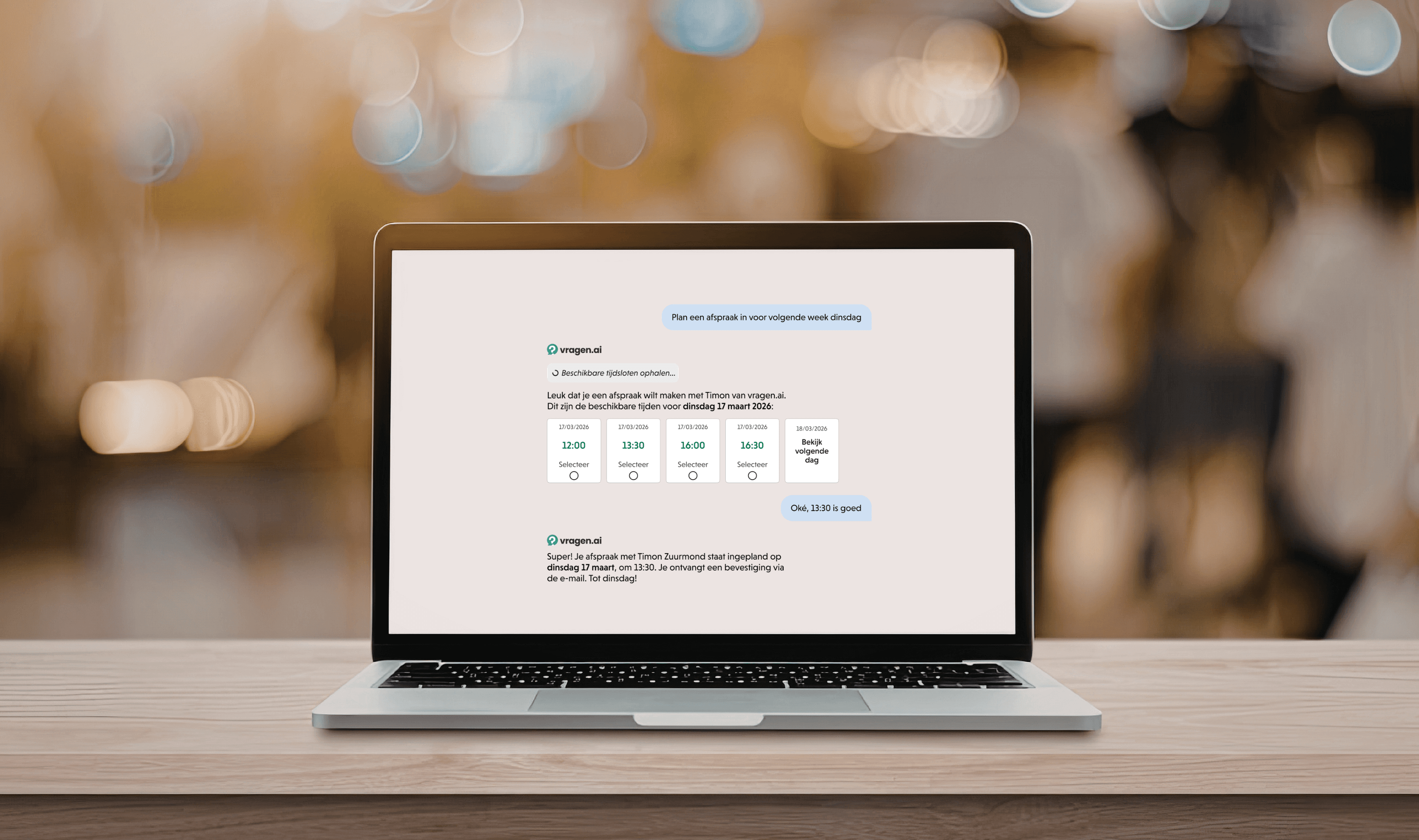
The real shift occurs when a website not only understands what someone wants but can act directly on it. For example, a visitor says: “I want to apply for a permit.” Or: “Schedule an appointment for next Tuesday.” Or simply: “I want to place this order.” The expectation is not that the website explains which steps are necessary but that the process is started immediately. This requires a different way of thinking and a different technical structure for websites.
When language gains access to systems
As long as AI only generates texts, the website remains informative. To move from conversation to results, language must be able to safely collaborate with underlying systems: inventory data, planning software, CRMs, internal processes.
A standardized coupling layer is needed for this. The Model Context Protocol (MCP) allows an AI to retrieve data in a controlled manner and prepare or execute actions within established business rules. The system can, for example, fetch a previous order, check current availability, and assemble a new shopping cart, without requiring the user to navigate through multiple screens.
The difference lies not in the presence of processes, as websites have always been able to support them, but in the access to them. AI makes it possible to control systems directly from the conversation, without the detours of traditional navigation and fixed flows.
More than reacting: thinking like agents
Besides system access, there is another important change: the way inquiries are processed. Where it started with reacting to a single prompt, agents can now go through multiple thinking steps before responding. They retrieve additional information, apply rules, compare options, and determine what the logical next step is.
Even more important is the ability to deploy different agents simultaneously. A service agent receives different instructions and has different priorities than a sales agent. An internal employee requires a different approach than an external customer. As a result, digital interaction becomes less generic and more tailored to the role of the user. The website does not behave as a single voice but as a collection of specialized functions.
Read more about agents in vragen.ai
When conversation becomes visual
Nevertheless, text alone is limited when it comes to choices or transactions. That's why we see a third development: integrating interactive elements into the conversation. Widgets enable products, schedules, status overviews, or comparisons to be shown directly in the conversation.
The answer is no longer: “Click here to proceed.” The answer is the next step. The user sees available time slots, adjusts quantities, or confirms a choice without leaving the conversation. Conversation and interface merge.
Read more about widgets in vragen.ai
Why the combination makes the difference
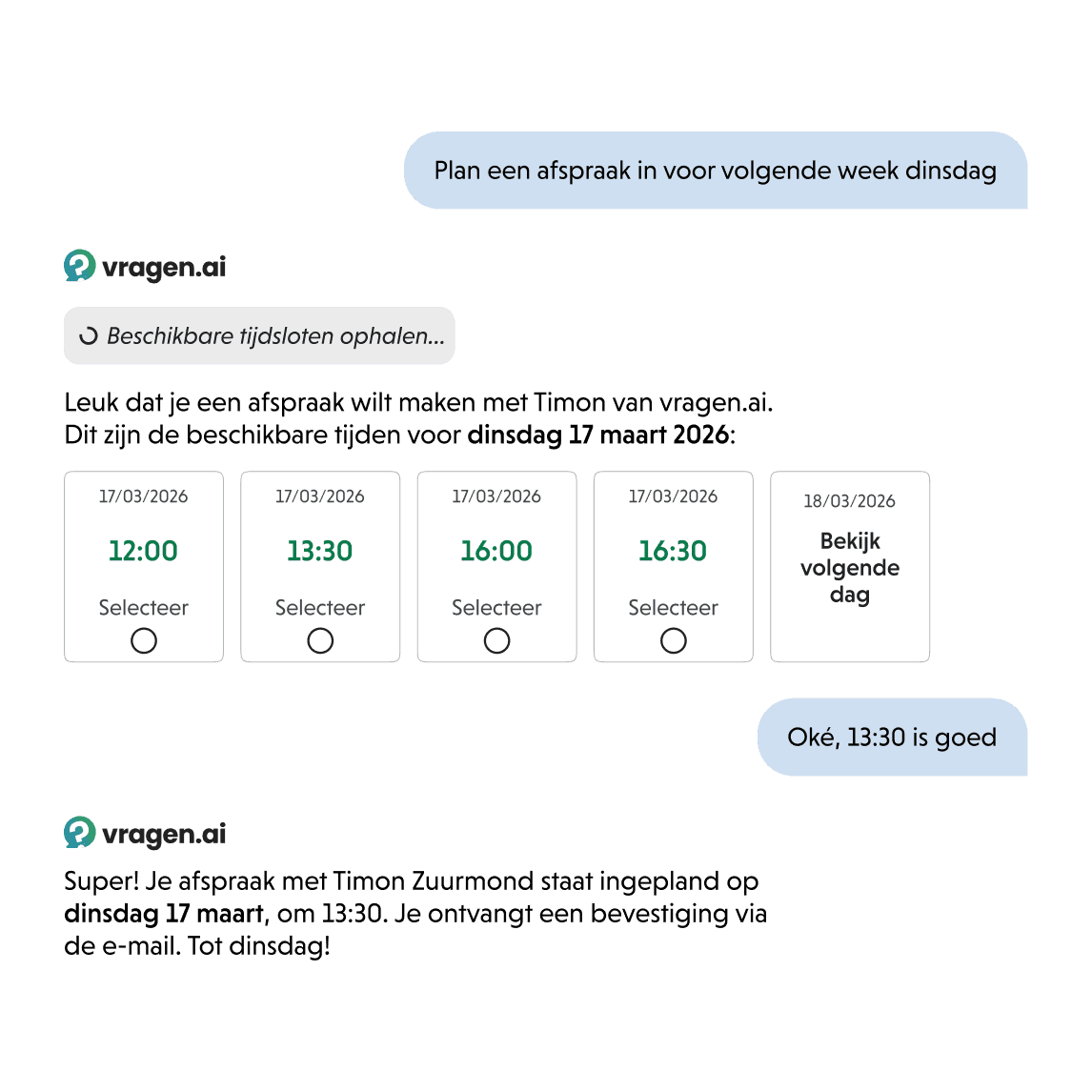
On their own, agents, system connections, and widgets are interesting innovations. Combined, they change the nature of the website. It's no longer about providing information but about facilitating concrete outcomes.
This interplay can be described as follows:
Component | Role in interaction |
|---|---|
Agent | Understands intention, reasons through multiple steps, and determines the appropriate next step |
MCP | Connects the conversation with underlying systems and enables controlled actions |
Widget | Makes information and actions visual, interactive, and directly executable within the conversation |
When these three layers work together, interaction shifts from question-and-answer to intention-and-result. The user no longer has to navigate through pre-designed structures but is supported in achieving a goal.
A different design question
Websites have naturally always been able to facilitate processes. Permits could be applied for, appointments scheduled, orders placed. The difference is not in what is possible but in how accessible it becomes.
With AI, access to these processes changes. No longer through fixed menus and pre-designed flows, but through intention. The user formulates a goal, and the system determines the fastest route to execution.
This requires a different way of thinking. Not just: which page do we show and what steps does someone go through? But also: which intentions do we want to support directly, and what systems are needed for that?
AI serves as a connecting layer here. Not to replace existing functionality but as an accelerator and connector. What used to be spread over pages and forms can now be brought together from one conversation.
The value of a digital environment subtly shifts. Not because processes are new, but because the path becomes shorter, more natural, and more adaptive. Less dependent on navigation, more focused on progress.
Getting started with vragen.ai
Within vragen.ai we make this concrete. Organizations can configure agents with specific roles and thinking steps, set up MCP connections to their own systems, and deploy widgets to make actions directly executable within the conversation. We support the establishment of this structure and the conversion of intentions into working interactions.
This does not mean you have to start large-scale immediately. You can start with one clear use case: a frequently asked question leading to a process, a scheduling module controlled from the conversation, or an order flow accelerated through intention. From there, functionality can be expanded step-by-step.
Thus emerges an environment where intention, knowledge, and action come together. The next step in conversational is not just better understanding. It's truly making it possible.