
Joris Meijer
Co-founder, AI Lead
With Vragen.ai, visitors ask their question in their own words. They instantly receive a reliable answer, based on your own content. Complete with source references, so it is always clear where the information comes from.
Until recently, this worked in a fixed sequence:
Retrieval – vragen.ai retrieves relevant pieces from your knowledge base.
Generation – based on that, it formulates an answer.
That works well, but has a limitation: there is only one search round. As a result, valuable context sometimes stays just out of sight.
With agent mode, that changes. Fundamentally.
What is agent mode?
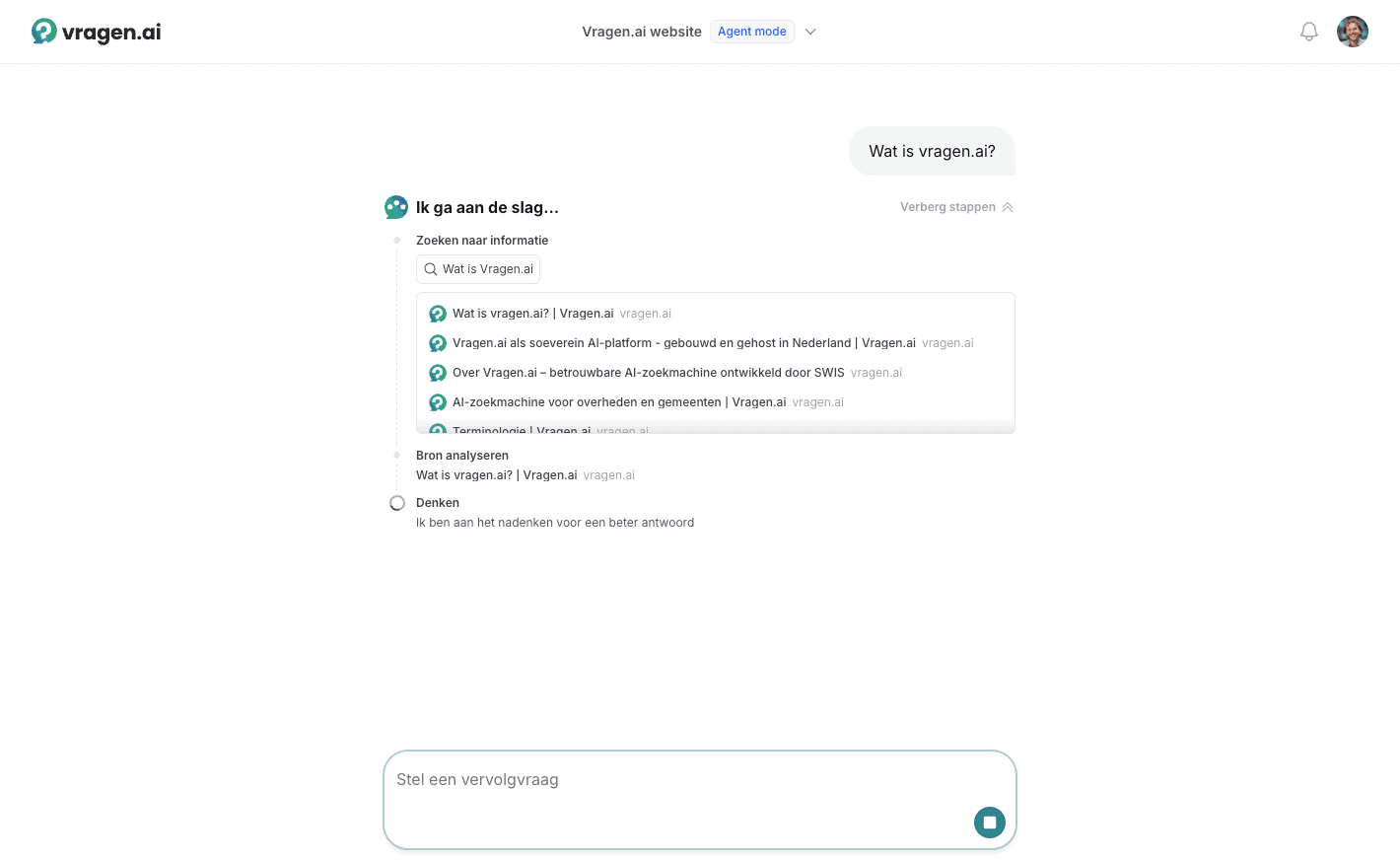
Agent mode (agentic AI) means that vragen.ai no longer performs a single linear step “search → answer”, but is allowed to independently take multiple search and thinking steps to arrive at the best answer.
The agent searches for relevant information.
Does it see that something is missing, or that another path is smarter?
Then it searches further.
Until the context is just right.
This way of working aligns with a broader development in AI: agentic RAG. Whereby systems search and reason iteratively, instead of trying to retrieve everything in one go.
What are the benefits?
1) Smarter retrieval process
An agent does not just search for what is literally in the question, but builds on what it finds in between steps. As a result, it retrieves broader and more relevant fragments.
Example:
A visitor asks a question about peer support on a patient platform.
The AI finds a fragment in which someone got in touch with others through the walk-in center.
The agent decides: there is something here. And searches further for similar experiences around the walk-in center.
This creates extra context before the answer is provided.
The result: less missed information, and a more complete answer.
2) More room for follow-up questions
Instead of just broadcasting, the agent becomes a conversational partner.
If something is not clear, it asks a counter-question.
It understands follow-up questions better, because it built up the context itself.
You get more of a sparring-partner experience than a Q&A.
3) Better citation of used sources
Agent mode also ensures sharper references within the source.
The used text is clearly highlighted on the page.
You see exactly which fragment was used, and why.
This gives confidence to end users.
Evaluations around agentic RAG call these kinds of ‘span-level citations’ a significant gain in quality.
Example: what can an agent do that was difficult before?
Question: “What is the phone number of the Product Owner of Team Delta?”.
An agent can now independently:
Find out who the Product Owner of Team Delta is.
THEN specifically search for contact details.
And only then provide the answer, with a source reference.
So you no longer have to come up with intermediate steps yourself or ask multiple separate questions. The agent does that for you.
Multiple agents: each with their own role and tone
A major benefit is that you can deploy multiple agents alongside each other, each with their own task and tone.
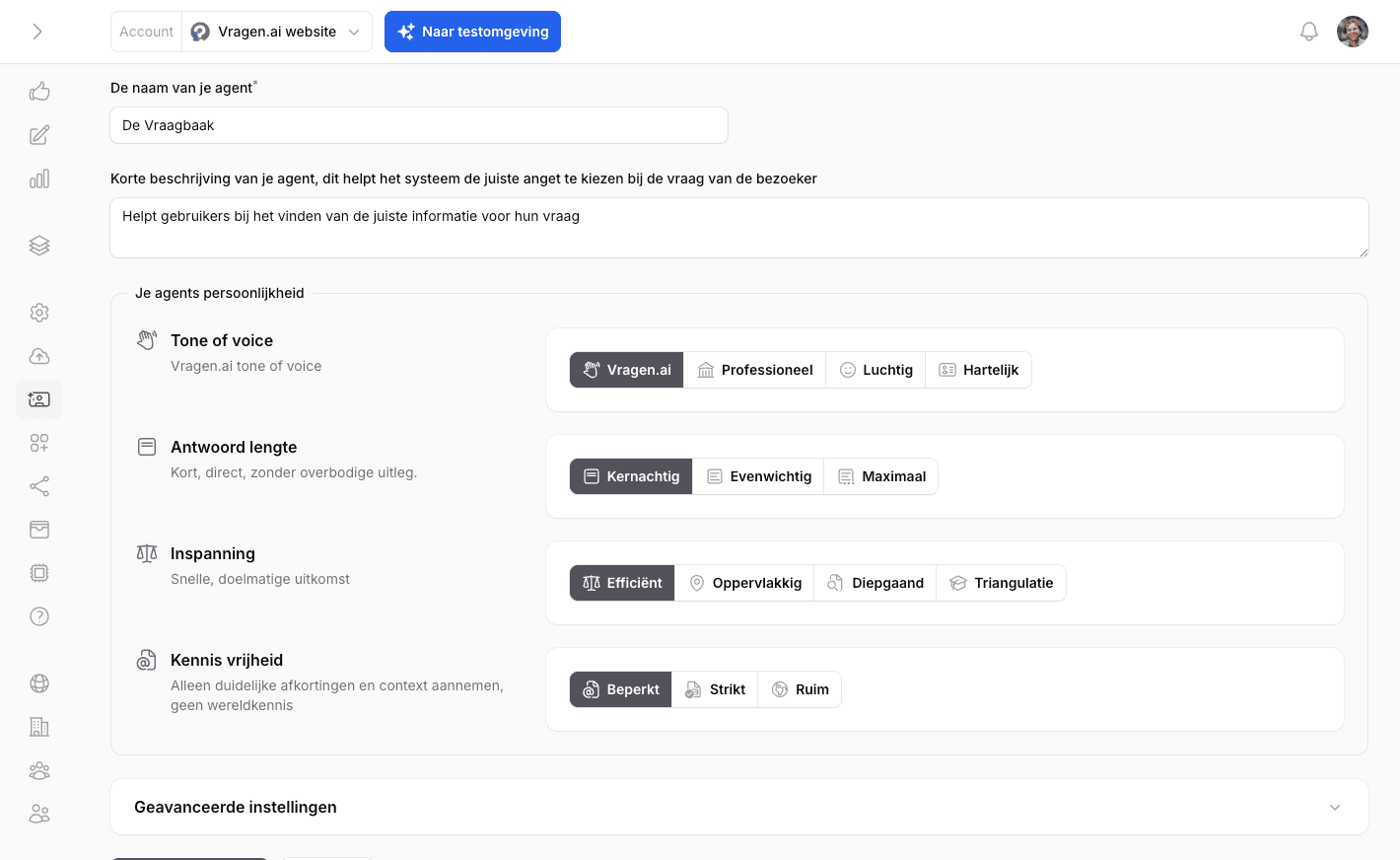
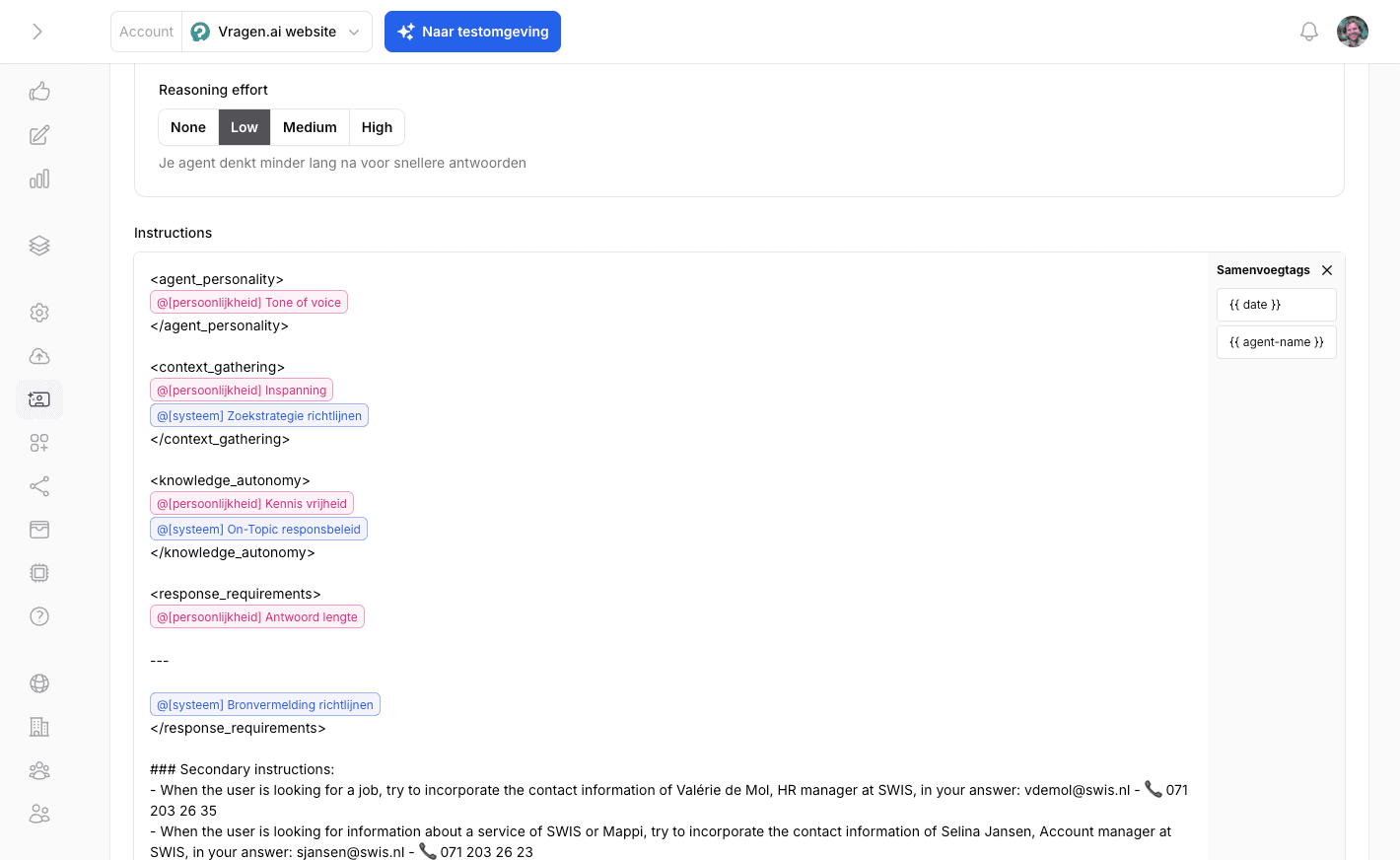
For each agent, you configure:
What it is intended for
What tone is desired (formal, friendly, concise…)
The length of the answers
Which documents from the knowledge base may be used
How much reasoning effort it gets
Creating them is very accessible: you choose a type, provide an instruction, and Vragen.ai automatically generates an appropriate prompt. You can always view or adjust this yourself.
Tip. Do you work with different target audiences? Create a separate agent for each target group. Tailored to the right tone, with sources that fit what that group needs.
What does the user notice?
For end users, it becomes more transparent how the answer is generated.
You see which steps the AI is taking to arrive at the answer.
Follow-up questions are part of it (agents work iteratively).
Source references are clearer and more sharply highlighted
That makes the answer not only better, but also verifiable.
Why this opens up possibilities for new applications
Because agents can independently search, ask follow-up questions, and reason, applications emerge that previously required high manual effort. Think of:
Smart customer service
The agent searches through FAQs, policies, and cases. And asks clarifying questions itself.Onboarding agent
Combines handbooks, project documents, and role information into a clear starting point for new colleagues.Policy or legal assistant
Establishes links between different versions, and flags gaps or ambiguities.Product or service advice
First gathers the right context, searches specifically, and only then gives appropriate advice.Live data integrations
Via an MCP integration, the agent can also retrieve external, up-to-date data. Such as stock, statuses, or CRM information.👉 Soon we will publish a separate article about what MCP exactly is and how to use it in combination with Vragen.ai.
In short: agent mode is not just an "extra button," but a way to use vragen.ai much more as an intelligent assistant.
In summary
With agent mode, vragen.ai changes from an AI search engine that searches once, into a digital partner that keeps searching, asks further, and builds up context.
You get:
Smarter, iterative retrieval
More active sparring and better follow-up questions
More accurate source references
And above all: room for new applications that were previously not possible